

Now Reading: Visiting the UAE from Elsewhere in the Gulf: The Complete Guide
-
01
Visiting the UAE from Elsewhere in the Gulf: The Complete Guide

Visiting the UAE from Elsewhere in the Gulf: The Complete Guide

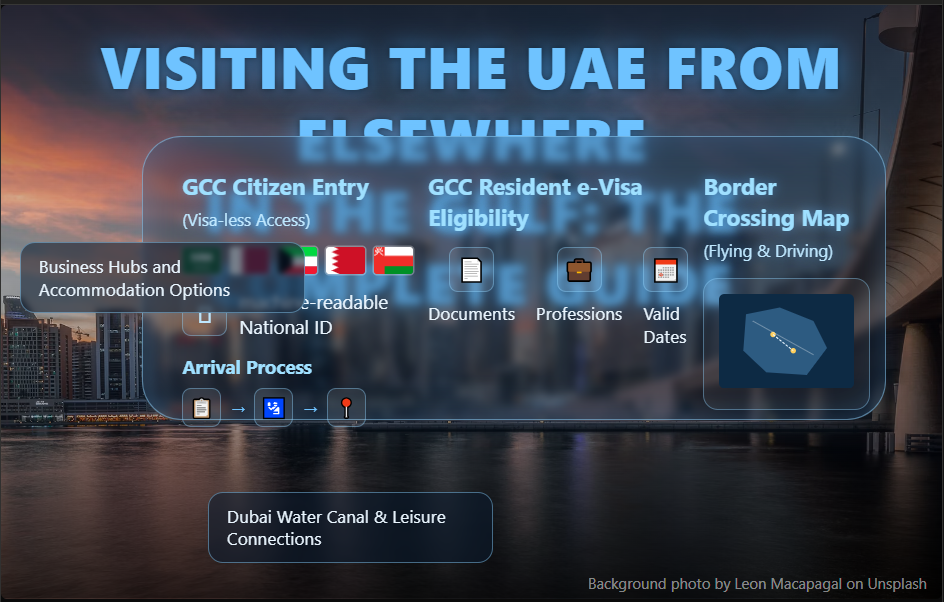
If you live anywhere in the Gulf — Saudi Arabia, Qatar, Kuwait, Bahrain, or Oman — hopping over to the UAE is about as painless as international travel gets. Most of the usual visa headache just doesn’t apply here, thanks to the GCC agreement. But here’s the part a lot of people get wrong: it’s not about where you’re flying from, it’s about who you are on paper. A Saudi citizen landing in Dubai goes through a completely different process than an Indian passport holder who’s spent the last ten years living and working in Riyadh. Same region, same flight time, totally different rules. This guide walks through both situations properly, plus everything else worth knowing before you cross the border.
Two Very Different Kinds of “Gulf Traveler”
The UAE splits Gulf-based travelers into two camps, and knowing which one you fall into matters more than people realize.
First up: GCC nationals. Actual citizens of Saudi Arabia, Qatar, Kuwait, Bahrain, or Oman, traveling on their own passport or national ID. Then there’s a second, much bigger group — GCC residents. These are foreign nationals, often from South Asia, Southeast Asia, or parts of Africa, who legally live and work in a Gulf country under something like a Saudi Iqama or a Qatar ID, without actually holding citizenship there. Sounds like a technicality. It isn’t. At the airport, it’s the difference between walking straight through and needing paperwork sorted weeks in advance. Figure out which bucket you’re in before you book anything.
So, Do GCC Citizens Need a Visa?
Nope. Citizens of GCC countries don’t need an entry visa, and don’t need anyone in the UAE to sponsor the trip. This traces back to the GCC Unified Economic Agreement from the early ’80s, which set up free movement between member states — and honestly, it still works the same way today. You show up, hand over your ID, get stamped in. That’s really it.
A few things worth knowing:
- A passport isn’t even mandatory — a GCC national ID card works just fine.
- Whatever you use, just make sure it’s current, and machine-readable if the crossing scans cards.
- No application, no approval letter, nothing to submit ahead of time.
- Kids traveling with a GCC national parent are usually fine too, as long as they’ve got their own valid ID or are listed on an accepted family document.
How Long Can You Actually Stay?
Most GCC citizens get 30 days on arrival to start. If the trip runs long, that’s not really a problem — it can typically be extended twice, 30 days each time, so you could stretch things to a full 90 days without ever leaving the country. Extensions usually go through GDRFA or ICP rather than being handled at the airport itself.
One thing to watch for: overstay without extending, and there’s a daily fine, commonly cited around AED 100, kicking in after a short grace period. These numbers shift now and then, so it’s worth double-checking on the UAE’s official portal close to your travel date rather than trusting a number you saw in some old blog post.
What If You Live in the Gulf But Aren’t a Citizen?
This is where people trip up, and it happens more than you’d think. Just because your whole life is based in Doha or Riyadh doesn’t mean the UAE treats you the same way it treats an actual Saudi or Qatari citizen. A Pakistani with a Saudi Iqama, a Filipino with a Kuwaiti Civil ID, an Indian with Qatari residency — none of them get the free-movement treatment, no matter how long they’ve lived there. What they need instead is something called the eVisa for GCC residents.
Are You Even Eligible?
It’s not just about your address on paper. A few boxes need to be ticked:
- Your GCC residence permit needs at least a year of validity left from your planned arrival date.
- Your passport needs at least six months left on it — this one trips people up constantly.
- Your profession has to be on the UAE’s approved list for this visa category. Not every job qualifies, and that catches a lot of applicants off guard.
- You need to actually be a resident of one of the six GCC states, and your specific nationality has to be one the scheme accepts.
- Depending on who reviews the application, you might also need proof of accommodation or a return ticket.
Actually Applying for It
This isn’t something you sort out at the airport counter. Most people apply online, days ahead of the trip.
- Get your passport, GCC residence card, and a UAE-compliant photo together.
- Head to the official UAE government platform, or the GDRFA Dubai page for GCC resident entry permits.
- Fill in your details exactly as they appear on your passport — a small typo here can cause real delays later — and upload the documents.
- Pick your visa duration and pay the fee.
- Wait for approval, which usually lands within a few working days.
- Save or print the approved permit, and carry it alongside your passport when you travel.
The visa itself runs for 30 days and can be extended once for another 30, so it’s worth planning your dates around that window rather than needing a second application halfway through the trip.
What to Carry at the Border
Whether you’re flying in or driving across, having your paperwork ready just saves everyone time:
- Original passport, or national ID if you’re a GCC citizen.
- Printed or digital eVisa approval, if you fall into the resident category.
- Proof of GCC residency — Iqama, Qatar ID, Kuwait Civil ID, whatever applies to you.
- A return or onward ticket, since some officers do ask for it.
- Hotel confirmation, or at least an address for where you’re staying.
- Extra documents for kids traveling with you, birth certificates included if requested.
Flying or Driving — Which Makes More Sense?
Depends entirely on where you’re coming from and how much time you’ve got. Flying wins on speed for longer distances. Driving wins on flexibility, especially if you’re already close to a shared border.
By Air
Dubai and Abu Dhabi have direct flights from every GCC capital, and flight times are short — often under two hours from Riyadh, Doha, Kuwait City, Manama, or Muscat. There’s enough daily capacity that last-minute bookings usually aren’t an issue, and immigration for GCC nationals tends to move quickly since there’s no visa counter slowing things down.
By Road
 Photo via Pexels
Driving is genuinely popular between the UAE and its immediate neighbors, particularly Saudi Arabia and Oman, given how long those shared borders run.
- Al Ghuwaifat is the main Saudi–Abu Dhabi crossing — the one most people from the Eastern Province or Riyadh use.
- Al Ain and Hatta connect the UAE with Oman, popular with travelers coming from Muscat or the Omani interior.
- You’ll need vehicle insurance valid in the UAE, either arranged before the trip or picked up right at the border.
- Wait times swing a lot with the season and time of day — travel outside peak holiday periods if you can, it makes a real difference.
When Things Go Wrong
Your GCC residency is about to expire? If there’s less than a year left on your residence permit, the eVisa application will probably get bounced. The fix is simple enough — renew your residency first, then apply for the UAE eVisa once the new expiry date is confirmed.
Refused entry at the border? Usually it’s an expired document, a mismatch between the visa and passport details, or a profession that doesn’t qualify. If it happens, ask the officer for the reason in writing if you can, then follow up with your visa service provider or GDRFA before trying again.
Overstayed your permit? Don’t wait until you’re heading to the airport to deal with it. Contact GDRFA or ICP the moment you realize the mistake — fines pile up daily, and sorting them out fast, along with any needed extension, keeps it from following you into future trips.
A Few Practical Extras
Best time to go: November through March is the sweet spot — mild enough during the day that desert safaris and beach days actually feel enjoyable rather than punishing. Summer gets brutally hot, though malls, indoor attractions, and hotel pools stay busy with Gulf visitors year-round regardless.
Money matters: The Dirham (AED) is pegged to the US Dollar, so exchange rates stay predictable enough to plan around. Currency counters are everywhere — airports, malls, hotels — and cards work almost anywhere, taxis included. Still, keep some cash handy for local transport and smaller vendors. And budget-wise, Dubai and Abu Dhabi run noticeably pricier than Sharjah or the northern emirates, so your itinerary shapes your costs more than people expect.
Staying connected: A lot of Gulf residents already have roaming plans that cover the UAE, so it’s worth checking with your home operator first before buying anything new. If not, Etisalat and du both sell prepaid SIMs at airport kiosks, and all you need is your passport to register.
Getting around: Ride-hailing apps cover Dubai, Abu Dhabi, and Sharjah well. Dubai’s metro handles most tourist and business areas efficiently. If you’re planning to explore further out, renting a car makes sense, and inter-emirate buses are a cheaper option than taxis for reaching smaller towns. Walking’s only really practical in a handful of districts — the climate takes care of the rest, most of the year.
 Photo via Pexels
Etiquette worth knowing: Dress modestly, especially around malls, government buildings, and religious sites. Public displays of affection can actually get you fined, which surprises a lot of first-time visitors. Be careful photographing government or military buildings, or people, without permission. Friday’s part of the weekend here, so business hours shift accordingly. Alcohol’s fine in licensed venues, but not out in public. And during Ramadan, quieter public behavior during fasting hours is expected of everyone, visitors included — it’s a small thing that goes a long way.
Quick Answers to Common Questions
Do GCC citizens need travel insurance for the UAE? Not legally required, but still a smart move for medical costs, lost bags, or a cancelled trip.
Can I use my national ID instead of a passport? Yes — GCC citizens can generally use a valid national ID at UAE airports and land borders.
Is the GCC resident eVisa basically a tourist visa? No. It’s its own category, built specifically for foreign nationals holding valid GCC residency, with its own rules and its own application process.
Can my family come with me under the same conditions? Mostly, yes — though everyone typically needs to meet the document requirements individually. Kids may be covered under certain family-based applications, depending on the visa type.
What if my job isn’t on the approved list? Then the eVisa application will probably get rejected. In that case, a standard UAE tourist visa, applied for based on your actual passport nationality, is likely the better route.
How early should I apply? A few days to a couple of weeks ahead is usually enough, since approvals often come through within a few working days. During busier travel seasons, though, give yourself some extra buffer — it’s cheap insurance against a delay.
Worth Reading Next
If you’re planning further, it’s worth also looking into UAE tourist visa rules for non-GCC nationalities, how Dubai and Abu Dhabi weather shifts season to season, and what to know about driving regulations and vehicle insurance when crossing Gulf borders by car.

Stay Informed With the Latest & Most Important News
Previous Post
Next Post
Previous Post

Next Post


Advertisement